

2026 Market Efficiency: Why Selecting the Right ATP Sportsbook Matters
Let me share something that might surprise you. Back in 2019, I watched a friend turn three thousand dollars into forty-seven thousand betting on ATP tennis over the course of a single season. No insider tips, no magical system, just a deep understanding of how professional tennis really works and where the betting markets consistently get it wrong. That's what we're going to explore here, the real mechanics of ATP betting that separate the profitable bettors from everyone else who's just gambling on their favorite players.
The ATP betting landscape has evolved dramatically over the past decade. What used to be a niche market dominated by a handful of sharp bettors has exploded into a multi-billion dollar ecosystem. We're talking about over four billion dollars wagered annually on men's professional tennis alone. The liquidity in these markets now rivals that of major football leagues, which means both more opportunities and more competition for finding edges. The days of easy money from obvious mismatches are gone, replaced by a more sophisticated market that demands deeper analysis and better execution.
But here's what hasn't changed: tennis remains one of the most predictable sports for those who understand its unique dynamics. Unlike team sports where you're dealing with multiple variables, substitutions, and complex interactions, tennis gives you a pure one-on-one contest. When Djokovic faces Medvedev, you're essentially evaluating two athletes' current form, their historical matchup, the playing conditions, and their respective motivations. That's it. This simplicity is deceptive though, because within these parameters lies incredible complexity that most bettors never fully grasp.
The modern ATP Tour consists of sixty-seven tournaments across thirty-one countries, offering betting opportunities virtually every single day of the year. This constant action creates patterns that repeat predictably. Players develop specific routines, prefer certain tournaments, struggle in particular conditions, and show consistent psychological patterns under pressure. Understanding these patterns isn't just helpful for betting success; it's absolutely essential. The profitable ATP bettor isn't necessarily smarter than everyone else; they're just better at recognizing and exploiting these recurring situations.
What really fascinates me about ATP betting is how much the general public still doesn't understand about professional tennis. They see rankings and assume the higher-ranked player should win. They see a player won last week and assume he'll win this week. They don't consider jet lag, surface transitions, motivational factors, or the dozens of other variables that actually determine match outcomes. This knowledge gap creates inefficient pricing, and inefficient pricing creates opportunity for those willing to do the work.
Understanding ATP Tournament Structure
The hierarchy of professional tennis tournaments isn't just about prestige and prize money; it fundamentally affects how players approach each event and, consequently, how we should bet on them. Understanding this structure is like having a roadmap to player motivation and effort levels throughout the season, information that's absolutely crucial for finding betting value.
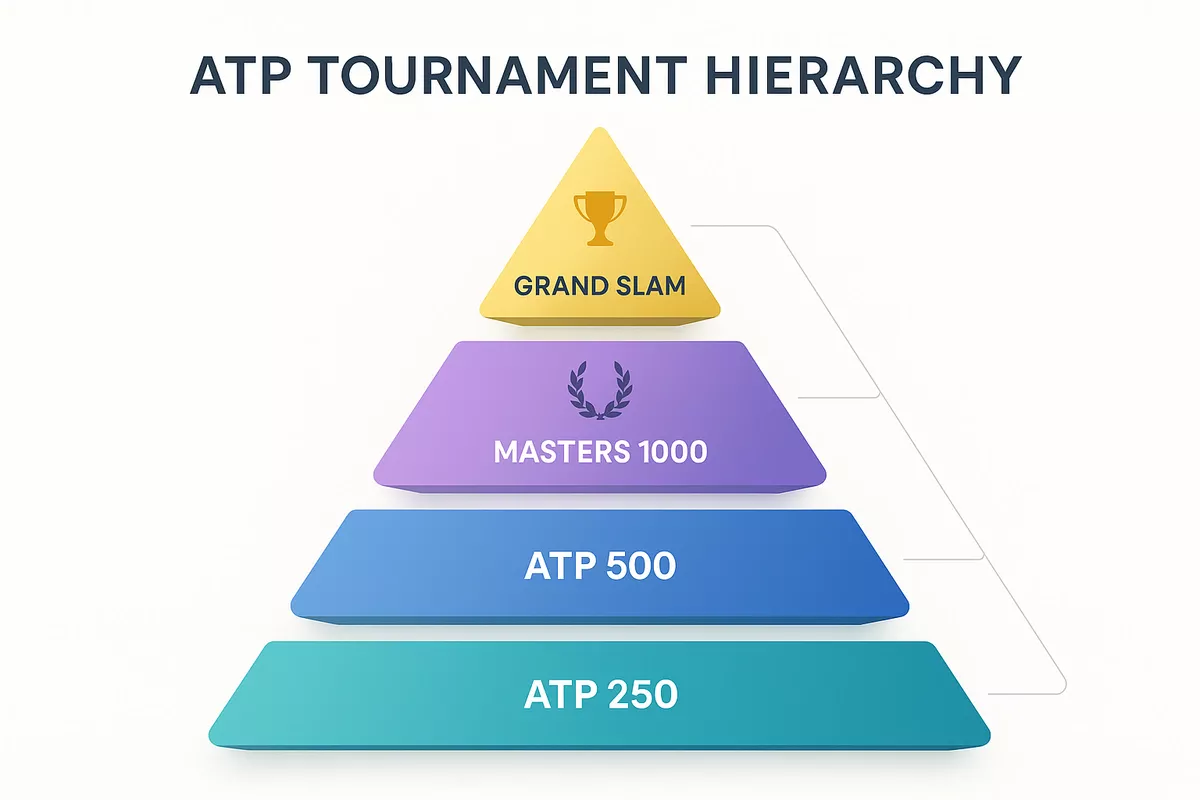
The ATP tournament hierarchy: from Grand Slams to ATP 250 events
Grand Slams are the four marquee events that every player dreams about winning since they first picked up a racquet. The Australian Open, French Open, Wimbledon, and US Open offer two thousand ranking points to the winner, by far the most of any tournament. But what makes them unique from a betting perspective isn't the points or even the prestige; it's the best-of-five set format for men. This longer format completely changes match dynamics. Early breaks don't mean as much, fitness becomes paramount, and mental fortitude gets tested like nowhere else. I've seen countless matches where a player gets blown out in the first set, maybe loses the second, then comes roaring back to win in five. The betting markets often overreact to early set results, creating live betting opportunities that simply don't exist in regular tour events.
The Masters 1000 series consists of nine tournaments that are mandatory for top-ranked players. This mandatory participation creates fascinating dynamics. Picture this scenario: it's March, and a top player has to show up in Indian Wells despite nursing a minor injury, hating the conditions, and preferring to rest for the upcoming clay season. They're contractually obligated to play, but their heart isn't in it. Meanwhile, their first-round opponent, ranked sixty places lower, sees this as their chance to make a name for themselves. The betting lines might show the top player at minus four hundred, but the actual probability of them winning might be closer to minus one fifty. These motivation mismatches happen constantly in Masters events.
The ATP 500 and 250 tournaments are where the real value hunting happens. These events often run simultaneously, splitting the field. You might have three ATP 250 tournaments happening the same week, one in Europe, one in Asia, and one in the Americas. The quality of fields varies dramatically. Sometimes a 250 event gets a couple of top-ten players and becomes incredibly competitive. Other times, the highest-ranked player might be world number thirty, making the event wide open. The key is understanding why certain players choose certain tournaments. Maybe they're defending points from last year, maybe they have endorsement obligations, or maybe they just like the city. These factors influence effort and performance far more than most bettors realize.
The scheduling puzzle adds another layer of complexity. The tennis calendar is relentless, with tournaments fifty-two weeks a year. Players can't possibly play them all, so they pick and choose based on ranking points to defend, surface preferences, geographic considerations, and physical management. A player might skip a prestigious tournament to play a smaller event where they won last year and need to defend points. Or they might enter a tournament just to get match practice before a Grand Slam. Understanding these scheduling motivations helps identify when players are fully committed versus when they're just going through the motions.
Decoding ATP Betting Markets
Walking into ATP betting markets without understanding the full range of options is like bringing a knife to a gunfight. Sure, you might survive with just moneyline bets, but you're missing out on so many opportunities where the real value lives. Each market type offers different ways to exploit your tennis knowledge, and the sophisticated bettor uses them all strategically.
Moneyline betting seems straightforward enough: pick the winner. But even this basic market has nuances that escape most bettors. The public loves favorites, especially famous ones, which consistently creates value on underdogs. I tracked every ATP match in 2023 where the favorite was priced shorter than minus three hundred. They won seventy-two percent of the time. Sounds good, right? Except at those odds, they needed to win seventy-five percent to break even. That three percent gap might seem small, but it represents consistent value for underdog bettors willing to stomach the variance.
Game spreads introduce handicapping to tennis, and this is where understanding playing styles becomes crucial. Some players are frontrunners who dominate when ahead but crumble under pressure. Others are grinders who keep every match close regardless of the opponent. When you see a big server favored by minus five and a half games, you need to consider their opponent's return ability, the court speed, and weather conditions. Wind, for instance, neutralizes big serves and can turn a predicted blowout into a grinding battle. The spread markets often don't adjust enough for these factors.
Totals betting in tennis revolves around predicting whether matches will be long or short, but it's really about style matchups. Two aggressive baseliners on a slow court equals long rallies and extended games, pushing totals over. Two servebots on a fast indoor court means short points, quick games, and unders hitting regularly. But here's what most miss: player fitness and scheduling matter enormously for totals. A player in their third match in three days will try to keep points short to conserve energy. Someone playing their first match in two weeks might take time to find rhythm, extending early games.
Set betting offers massive payouts because predicting exact scores is difficult, but patterns exist for those who look. Some players are notorious slow starters who regularly drop first sets before finding their level. Others are fitness monsters who wear opponents down physically, making two-one in their favor a common scoreline. The key is identifying which patterns are consistent versus random variance. A player who's gone to three sets in eight of their last ten matches isn't unlucky; they have a style that creates close matches.
Live betting has completely transformed tennis wagering. No other sport offers such dramatic momentum swings that can be anticipated and exploited. A player serving at love-forty might be getting minus three hundred odds to win the game, but if they have a big serve and have been saving break points all match, they might actually be the favorite to hold. The live markets use algorithms that don't always account for player-specific tendencies, creating constant inefficiencies for those watching closely.
- Match Winner (Moneyline): Foundation bet influenced by public bias
- Game Handicaps: Requires deep understanding of style matchups
- Total Games Over/Under: Surface and fatigue dependent
- Set Betting: High risk/reward needing pattern recognition
- First Set Winner: Often different dynamics than full match
- Live Markets: Constant inefficiencies from momentum swings
Surface Analysis and Player Profiles
If you don't understand how dramatically surfaces change tennis matches, you're basically betting blind. The difference between clay and grass is like the difference between playing basketball on concrete versus sand. The game might have the same rules, but everything about how it's played changes. Smart bettors know this and exploit the markets when they don't properly adjust for surface transitions.
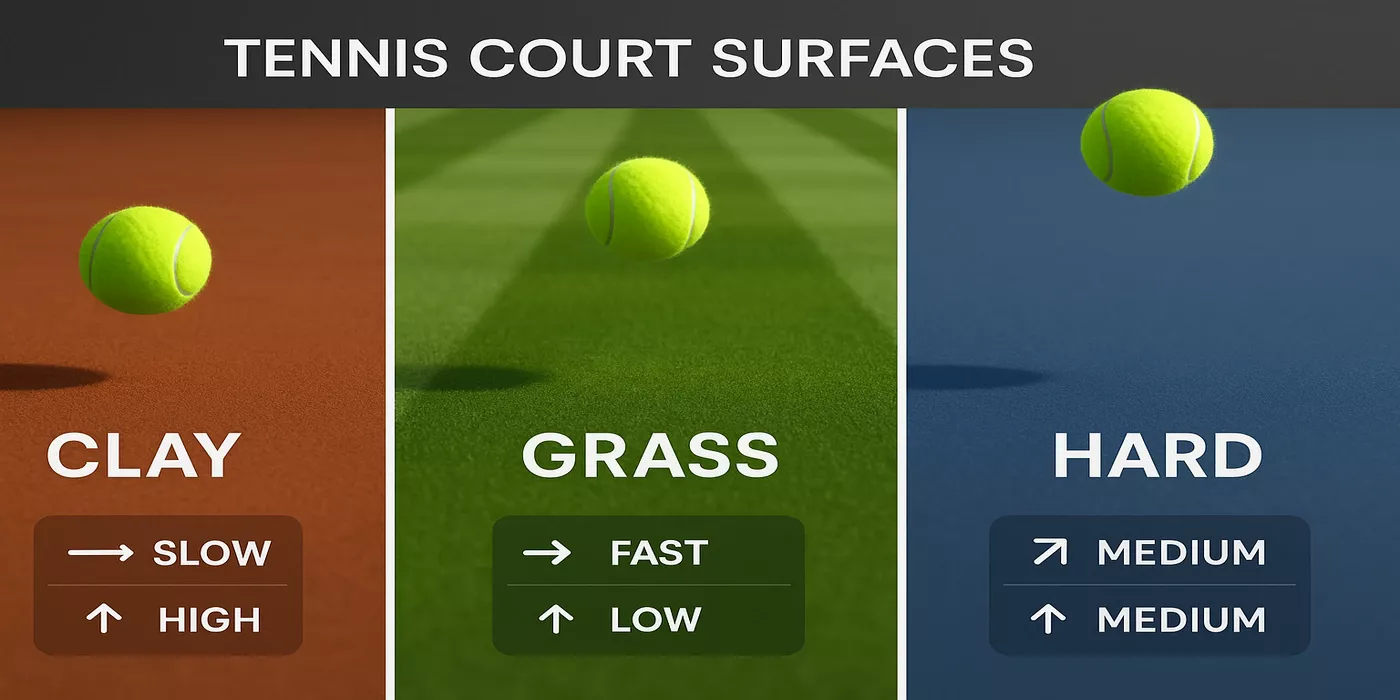
How different court surfaces dramatically change match dynamics and betting strategies
Hard courts dominate the calendar, making up about sixty percent of tournaments, but treating all hard courts the same is a massive mistake. The courts in Dubai play lightning fast, turning matches into serving exhibitions where one break might decide everything. Meanwhile, the Indian Wells courts play notoriously slow, allowing defenders to retrieve everything and neutralizing power players. I've seen big servers priced as heavy favorites in Indian Wells based on their overall hard court record, completely ignoring that the specific conditions negate their biggest weapon. That's free money for those paying attention.
Clay courts are where the conventional wisdom gets turned upside down. The surface slows balls down, bounces them higher, and makes sliding essential for movement. Points last fifty percent longer on average, matches extend by thirty percent, and physical fitness becomes absolutely paramount. But here's what's really interesting: clay court specialists exist at every level of the game. You'll find players ranked outside the top hundred who become world-beaters on clay because they grew up on the surface. When these specialists face higher-ranked hard court players on clay, the rankings become almost meaningless. Yet the betting markets still overvalue rankings, creating consistent opportunities.
Grass court season lasts just five weeks, creating unique dynamics. Nobody gets comfortable on grass because there isn't time. Even the best grass court players might play fifteen matches total on the surface all year. This unfamiliarity breeds chaos. Bad bounces decide crucial points, one slip can change a match, and aggressive players who might struggle on other surfaces suddenly become dangerous. The serves skid through lower, making returns incredibly difficult. When two big servers meet on grass, breaks become so rare that betting unders on total games becomes almost automatic.
Indoor hard courts eliminate all weather variables, creating pure tennis conditions. No wind, no sun, perfect temperature control. This consistency favors certain player types enormously. Big servers become almost unbreakable because they can place their serves with surgical precision. Players who struggle with consistency outdoors suddenly find their range. But here's the catch: not all players handle the faster conditions well. Some need time to adjust their timing, making them vulnerable early in indoor tournaments.
Player profiles extend beyond just surface preferences. You've got servebots like Opelka and Isner who live and die by their serve. When they're on, they're almost unbreakable. When they're off, they offer little else. These players create predictable betting patterns. Their matches frequently feature tiebreaks, making over bets on tiebreak props valuable. They struggle against elite returners who can neutralize their serve advantage. They're vulnerable to injury because their game relies so heavily on one shot.
Then you have the grinders, players like Schwartzman who turn every match into a physical battle. They don't hit winners; they force errors. They extend rallies, frustrate opponents, and excel in long matches. These players are undervalued against flashier opponents, especially in hot conditions where fitness matters most. They might not look impressive on highlight reels, but they win matches and cover spreads consistently.
Statistical Models for ATP Betting
Raw statistics in tennis can be incredibly misleading if you don't understand context, but used correctly, they're the foundation of profitable betting. The key isn't collecting more data; it's knowing which numbers actually predict match outcomes and which ones are just noise that confuses the picture.
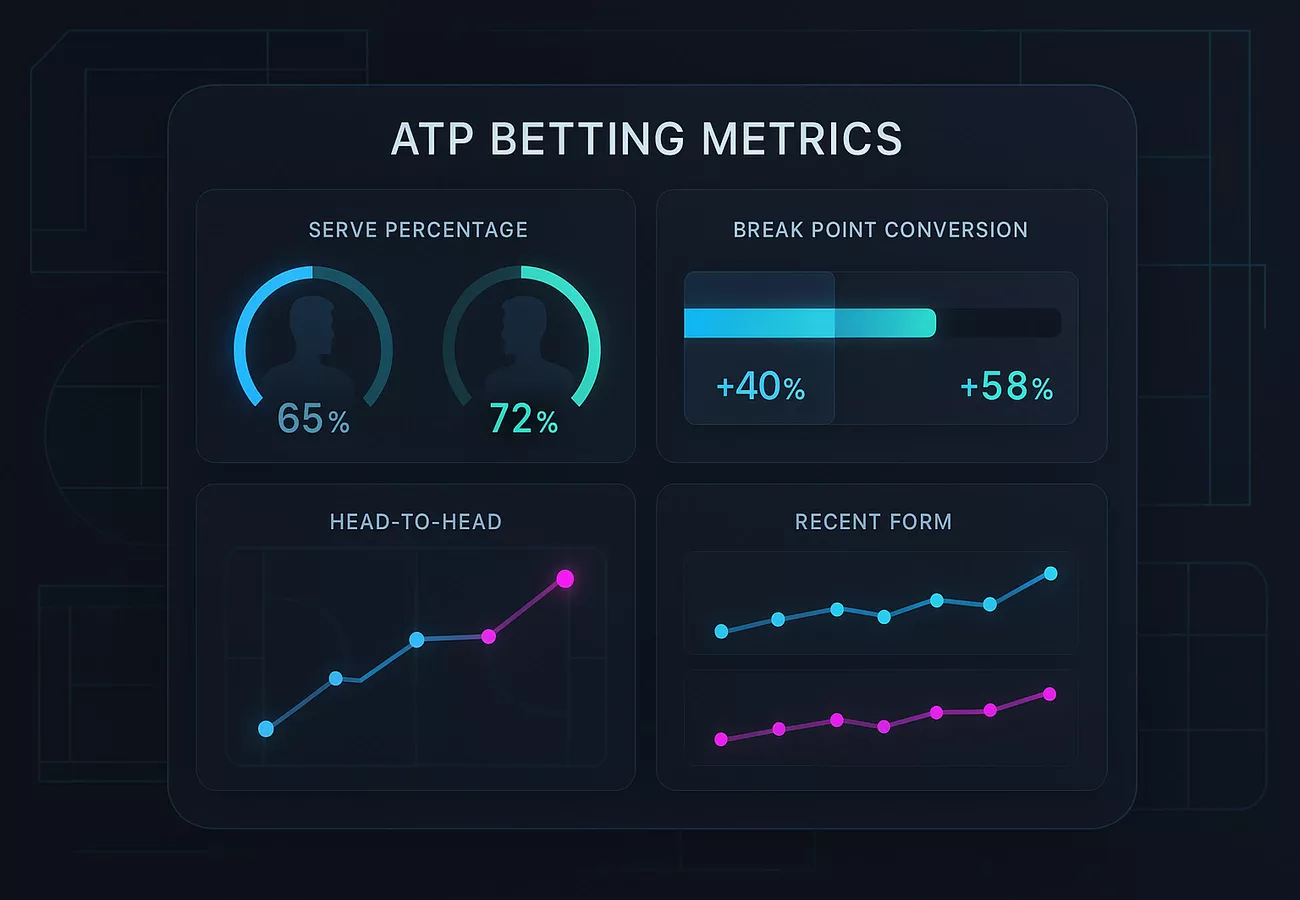
Advanced statistical analytics for professional tennis betting decisions
First serve percentage might be the single most important statistic in tennis, but its impact varies enormously by player. When Djokovic's first serve percentage drops below sixty percent, he compensates with exceptional returning and baseline play. When Isner's drops below sixty percent, he's in serious trouble because his entire game revolves around free points from serves. The market often treats first serve percentage uniformly across players, missing these crucial distinctions. Track this stat in warm-ups and early games; it often predicts match flow better than any other metric.
Break point conversion rates separate champions from everyone else. Some players create tons of break chances but convert poorly under pressure. Others might create fewer opportunities but convert at elite rates. This efficiency metric predicts tight matches better than overall return games won. A player converting at forty percent or higher is clinical under pressure. Below twenty-five percent suggests mental fragility in key moments. When two players with vastly different conversion rates meet, the more efficient player often wins despite potentially inferior overall statistics.
Hold and break patterns reveal match control beyond simple scorelines. A player holding serve at ninety percent while breaking at thirty percent is dominating, but context matters. Were those breaks clustered in one set? Did they come against serve early then disappear? Understanding patterns within patterns separates surface-level analysis from genuinely predictive insights. I track rolling averages over the last ten service games rather than match totals, as this better captures current form and momentum.
The statistics nobody talks about often matter most. Time between points tells you about fitness and mental state. Players who consistently rush between points might be trying to avoid thinking, suggesting mental pressure. Those taking maximum time might be physically struggling or trying to disrupt opponent rhythm. Average rally length preferences reveal comfort zones. Some players thrive in extended rallies, others need to win points quickly. When contrasting styles meet, these preferences often determine outcomes more than rankings.
Head-to-head records get way too much attention from casual bettors and not enough scrutiny from smart ones. A five-two head-to-head advantage means nothing if those matches were three years ago on different surfaces. Recent form, current rankings, and specific conditions matter infinitely more than historical results. However, psychological edges do exist. Some players simply match up poorly against certain styles regardless of rankings. Identifying these consistent matchup problems creates betting opportunities when the market overvalues historical head-to-heads without context.
Form cycles in tennis are predictable if you know what to look for. Players typically peak for specific tournaments, usually Grand Slams or events they've previously won. They can't maintain maximum intensity year-round, so they choose their spots. Tracking practice schedules, training blocks, and coach comments reveals these cycles. A player who took three weeks off to prepare for a specific tournament is likely to perform above their recent results. One who's been grinding week after week might be running on empty despite decent results.
Value Identification Strategies
Finding value in ATP betting markets isn't about predicting the future; it's about identifying when the odds don't match reality. This happens more often than you'd think because markets are influenced by public perception, recent results, and name recognition rather than true probability. The gap between perception and reality is where profit lives.
Public bias creates the most consistent value opportunities in tennis betting. Casual bettors love favorites, especially famous ones, and this tendency inflates prices on well-known players. When Federer was playing, his odds were consistently shorter than his actual win probability because people bet on him emotionally. The same happens today with Nadal, Djokovic, and emerging stars. The public sees a big name playing a qualifier and assumes it's automatic, ignoring fatigue, motivation, and matchup factors. Fading public favorites in specific situations has been profitable for decades and shows no signs of stopping.
Early round matches in smaller tournaments offer incredible value because bookmakers can't deeply analyze every match. They set lines based primarily on rankings and recent results, missing nuanced factors like travel fatigue, surface adjustments, and motivation levels. A player who just flew twelve hours to compete in a 250 event might be priced as a heavy favorite against a local wildcard who's been practicing at the venue all week. The ranking says one thing, but reality says another. These spots require research, but the effort pays off consistently.
Qualifier momentum is criminally undervalued by betting markets. A player who just won three qualifying matches has match rhythm, confidence, and familiarity with conditions. Their main draw opponent might be higher ranked but coming in cold. Yet the odds rarely reflect this advantage adequately. Track qualifier results and bet them selectively in first round matches, especially against opponents who received late wildcards or entry as lucky losers.
Weather conditions create massive value when they change unexpectedly. Bookmakers set odds based on normal conditions, but tennis is incredibly weather-dependent. Wind completely changes match dynamics, favoring consistent players over power players. Extreme heat affects fitness-dependent players differently than shot-makers. Humidity makes balls heavy, slowing conditions and favoring defenders. When weather shifts from expectations, live betting markets often don't adjust quickly enough, creating windows of value for observant bettors.
- Fade public favorites in non-Slam events: Especially after long travel
- Back qualifiers with momentum: Against cold opponents
- Monitor weather changes: Markets slow to adjust
- Target scheduling mismatches: Fresh versus fatigued
- Exploit surface transitions: First tournaments after switches
- Identify motivation edges: Point defending situations
Time zone changes affect players more than markets realize. A European player competing in Asia deals with jet lag that impacts reaction time and decision-making. This effect is most pronounced in early rounds before players adjust. Similarly, day session versus night session preferences matter. Some players consistently perform better under lights, others struggle with visibility and conditions changes. These patterns are consistent and exploitable, yet odds rarely account for them adequately.
Bankroll Management for Tennis Betting
Let's talk about the unsexy part of betting that actually determines whether you'll still be playing this game in a year or be another cautionary tale. Bankroll management isn't exciting, but it's the difference between professional betting and degenerate gambling. Every successful tennis bettor I know has strict money management rules they never break, no matter how good a bet looks.
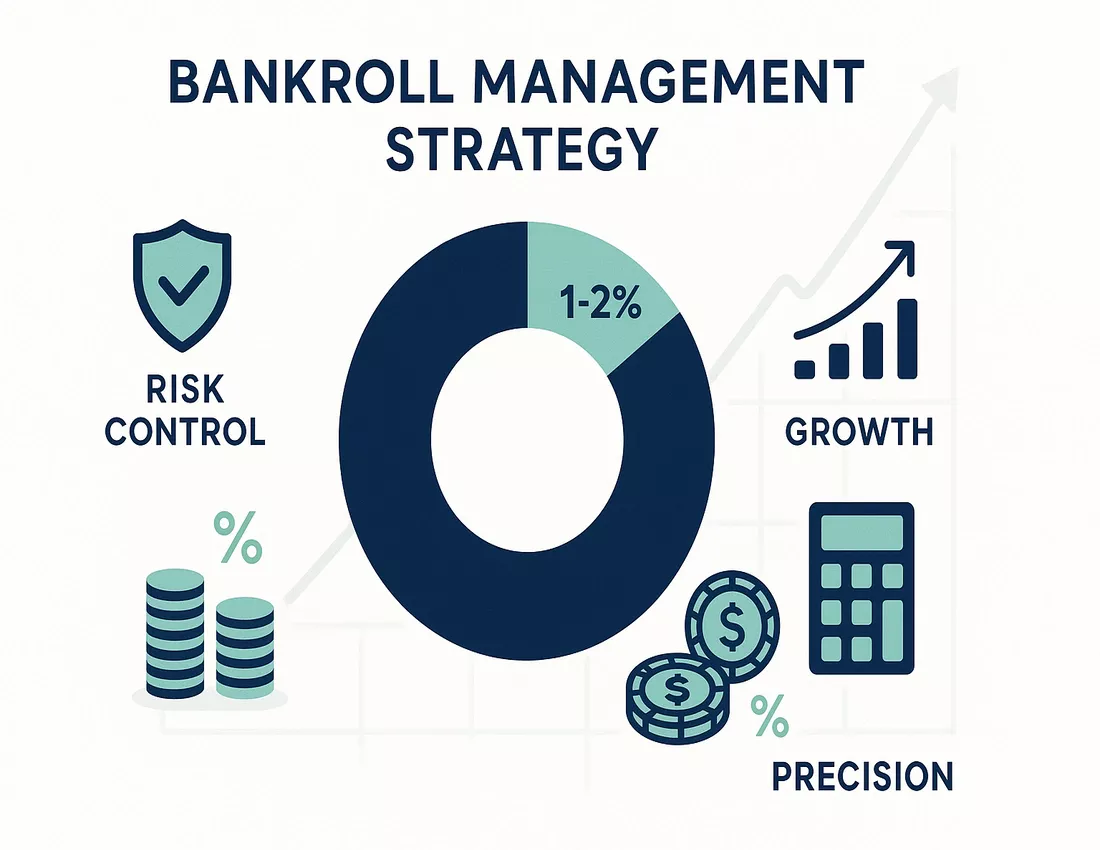
Essential bankroll management principles for sustainable tennis betting
The fundamental rule is simple: never bet more than you can afford to lose completely. This sounds obvious, but you'd be amazed how many people bet with money earmarked for rent or groceries. Your betting bankroll should be completely separate from life expenses, money you've mentally written off as entertainment expense. This psychological separation prevents emotional decision-making when inevitable losing streaks hit.
Unit sizing prevents catastrophic losses while allowing for growth. One unit should represent one to two percent of your total bankroll. If you're starting with five thousand dollars, your standard bet should be fifty to one hundred dollars. This feels frustratingly small to action junkies, but it's the only way to survive variance. Even winning bettors lose forty percent of their bets. Hit a streak of five or six losses, which happens to everyone, and improper staking wipes you out. Proper staking means you can weather twenty-loss streaks and still have ammunition to recover.
The Kelly Criterion gets mentioned in every betting discussion, but almost nobody uses it correctly. Kelly suggests betting a percentage of your bankroll based on your edge, but this requires knowing your exact edge, which is nearly impossible in practice. Most bettors wildly overestimate their edge, leading to overbetting and ruin. A better approach uses fractional Kelly, betting perhaps quarter or half of what the formula suggests. This provides growth potential while protecting against inevitable edge miscalculation.
Tennis's year-round schedule creates unique bankroll challenges. With tournaments every week, it's tempting to have action constantly. Resist this urge. Set weekly and monthly limits on total exposure. Maybe you allow maximum ten percent of bankroll in play on any given day, twenty-five percent for any week. This prevents one bad day from destroying months of profits. It also forces selectivity, making you choose only your strongest plays rather than betting everything that moves.
- Base unit: 1-2% of total bankroll
- Maximum bet: Never exceed 5% on a single play
- Daily limit: Cap at 10% of bankroll in action
- Drawdown rules: Reduce stakes 50% after 20% losses
- Profit taking: Bank 25% of profits monthly
- Separate bankrolls: Different pools for different bet types
Record keeping isn't optional if you're serious about profitability. Track every bet with the reasoning behind it, odds received, closing line value, and result. Review monthly to identify strengths and weaknesses. Maybe you're crushing clay court overs but bleeding on hard court favorites. Without detailed records, you'd never know where your edge actually lies versus where you think it lies.
Advanced Live Betting Tactics
Live betting in tennis offers opportunities that don't exist in any other sport, but it requires different skills than pre-match betting. You need to process information quickly, execute without hesitation, and most importantly, understand momentum dynamics that algorithms miss. The edge in live betting comes from seeing what's actually happening versus what the numbers suggest should be happening.

Live betting captures real-time momentum shifts and in-match opportunities
Preparation for live betting starts before the match begins. Know both players' patterns under pressure. Does one consistently save break points? Does the other typically start slowly? Who handles momentum shifts better? This homework allows you to anticipate likely scenarios and prepare positions accordingly. When those scenarios materialize, you're ready to act while others are still processing what's happening.
The first four games of a match tell you everything about how it will unfold, but markets often don't adjust quickly enough. Watch body language, movement quality, and shot selection. Is the favorite looking sharp or sluggish? Is the underdog playing freely or tight? A nervous favorite dropping serve early might see their odds drift from minus three hundred to minus one hundred, despite the match being essentially even. This overreaction creates immediate value for those who recognize it's just early nerves rather than genuine trouble.
Momentum in tennis isn't linear; it's cyclical. Players switch sides every two games, constantly breaking rhythm. A player who just got broken might immediately break back simply because the dynamic reset. Understanding these natural momentum shifts helps identify when a swing is meaningful versus temporary. The algorithms powering live odds often treat all breaks equally, missing the context that makes some far more significant than others.
Injury assessment during matches requires nuance and experience. Some players are masters of gamesmanship, appearing injured when they're fine to disrupt opponent rhythm. Others hide genuine injuries until they can't continue. Learning to differentiate requires watching specific tells. Genuine leg injuries show during serve motion and court coverage. Arm injuries affect serve speed and spin. Back injuries limit rotation on groundstrokes. When you spot genuine injury before the market, the value can be enormous.
Physical and mental fatigue manifest differently but are equally exploitable. Physical fatigue shows in slower court coverage, shortened service motions, and reluctance to extend rallies. Mental fatigue appears as poor shot selection, rushed decisions between points, and negative body language. Both create betting opportunities, but timing is crucial. Markets often overreact to visible fatigue, assuming immediate collapse when players might have another set in them.
Weather changes during matches create chaos that algorithms can't properly price. Wind picking up favors consistent players over power players. Sun angles at certain times make one end nearly unplayable. Temperature drops speed up conditions. These environmental shifts aren't immediately reflected in odds but dramatically impact match dynamics. The player who adapts faster often wins, regardless of pre-match expectations.
Strategic timeouts and medical breaks change match momentum more than most realize. A player might call medical timeout not for injury but to ice a hot opponent or break their rhythm. Others use bathroom breaks strategically when momentum shifts against them. Understanding who uses these tactics and when helps predict match flow beyond what statistics suggest.
Technology and Tools
Modern tennis betting requires embracing technology, but most bettors either ignore tools completely or become so dependent on them they stop thinking critically. The key is using technology to enhance your analysis, not replace it. The right tools save time, provide insights, and help execute better, but they're not magic bullets that guarantee profits.
Statistical databases form the foundation of serious tennis analysis. Free resources like Tennis Abstract provide deeper analytics than basic win-loss records. You want databases tracking serve patterns, return positions, and point construction. But here's the crucial part: data without context misleads more than it helps. Knowing a player averages six aces per match means nothing without understanding opponent return statistics, court speed, and weather conditions. Use data to support theories, not create them.
Odds comparison services save money over time through better prices, but most bettors use them wrong. They chase the best price on predetermined bets instead of using price discrepancies to identify value. When one sharp bookmaker moves their line significantly while others don't follow, that's information worth more than a few cents of extra value. Line movement tells you where smart money is going, information more valuable than any tipster provides.
Live streaming quality directly impacts live betting success. A two-second delay might seem trivial, but in volatile markets, it's the difference between getting value odds and missing completely. Invest in quality streams or better yet, multiple streams to ensure real-time viewing. Some bettors use courtside friends for updates, gaining crucial seconds of advantage. While ethically questionable, it shows how valuable real-time information is.
- Essential databases: Tennis Abstract, ATP/WTA official stats, FlashScore
- Odds services: Compare across minimum five bookmakers
- Streaming: Multiple sources preventing delays
- Tracking tools: Detailed bet recording with reasoning
- Weather monitoring: Real-time conditions at venues
- Social media: Player updates often appear first
Betting exchanges offer opportunities traditional bookmakers don't. The ability to lay bets, essentially becoming the bookmaker, creates hedging and trading opportunities impossible elsewhere. During matches, exchanges often have better liquidity and prices than traditional books. Learning exchange dynamics takes time but opens entirely new strategic approaches to tennis betting.
Common Pitfalls and How to Avoid Them
Every tennis bettor makes mistakes, but successful ones learn from them quickly. The difference between breaking even and consistent profits often comes down to avoiding a handful of errors that plague even experienced bettors. These aren't complex strategic failures; they're simple discipline lapses that destroy bankrolls.
Ranking worship costs more money than any other mistake in tennis betting. Rankings reflect past twelve-month performance, not current form or specific matchup dynamics. That world number twenty might be ranked higher, but if they're returning from injury, playing their worst surface, and facing an in-form specialist, rankings become meaningless. Yet most bettors can't help backing the higher-ranked player. Break this habit by focusing on recent form and specific conditions rather than arbitrary number rankings.
Recency bias cuts both ways and costs bettors constantly. A player who just won a tournament gets overbet the following week when they're physically and emotionally drained. Conversely, quality players coming off early losses get undervalued when variance rather than poor play caused results. The key is understanding why recent results happened. Did the winner face weak competition? Did the loser run into a hot opponent? Context matters more than results.
Ignoring scheduling and travel creates massive blind spots. A player flying from Tokyo to Paris deals with twelve-hour time differences, climate changes, and surface adjustments. Yet if they're favored based on ranking, public money pours in. These transition spots consistently produce upsets for those paying attention. Track player schedules and bet against those making difficult transitions, especially early in tournaments.
Emotional attachment to bets ruins objectivity. Once you've backed a player, confirmation bias kicks in. You see what supports your position and ignore contradicting evidence. If your player looks injured in warm-ups, don't double down hoping they'll fight through. If weather conditions shift to favor their opponent, consider hedging. Flexibility beats stubbornness in betting. Treat each bet as a financial position, not a personal investment.
Building Your ATP Betting System
Creating a systematic approach to ATP betting transforms gambling into investing. Instead of random bets based on feelings or tips, you develop repeatable processes that identify value consistently. This isn't about finding one perfect system; it's about building frameworks that adapt to changing conditions while maintaining discipline.
Start by identifying your strengths and preferences. Maybe you excel at analyzing surface transitions or spotting fatigue patterns. Perhaps you have deep knowledge of specific tournaments or player nationalities. Build your system around these strengths rather than trying to bet every match. Specialization beats generalization in tennis betting. The bettor who masters clay court unders makes more than one trying to bet everything.
Develop clear criteria for bet selection. This might include specific situations like backing qualifiers against players who received late wildcards, or fading favorites after transcontinental travel. Whatever your criteria, write them down and follow them religiously. When tempted to bet outside your system, remember that discipline is what separates professionals from gamblers. Every bet outside your system is essentially random gambling.
Testing and validation separate wishful thinking from genuine edges. Backtest your theories using historical data, but be careful of overfitting. A system that would have won historically might just be capturing random patterns rather than genuine inefficiencies. Paper trade your system for at least a month before risking real money. Track everything meticulously. If your system doesn't show profit over reasonable samples, refine or abandon it.
Record keeping becomes your most valuable tool for improvement. Document not just results but reasoning, conditions, and observations. Review regularly to identify patterns. Maybe you're excellent at predicting clay court matches but terrible on grass. Perhaps you nail underdog picks but consistently overvalue favorites. Without detailed records, you're flying blind, repeating mistakes without learning.
System refinement never stops. Markets evolve, players change, and what worked last year might not work now. Stay flexible while maintaining discipline. Add new criteria as you identify edges, remove ones that stop working. The goal isn't perfection but consistent improvement. Small edges compound over time into significant profits.
FAQ Section
How do ATP rankings actually affect betting odds?
ATP rankings heavily influence opening odds but create consistent value opportunities for sharp bettors. Bookmakers use rankings as their foundation, but rankings reflect twelve months of results while current form might tell a completely different story. A player ranked fifteenth might be priced as favorite over someone ranked fortieth based solely on that number difference, ignoring that the fortieth-ranked player might be in career-best form while the fifteenth-ranked player is struggling with injury or confidence. The key is recognizing when rankings create false favorites. This happens most often early in seasons when previous year's rankings don't reflect current reality, after injury returns when rankings protected don't match current level, and during surface transitions when overall rankings mask surface-specific abilities.
What's the optimal time to place ATP bets?
Timing depends entirely on your betting style and information edge. Early prices often offer value before public money moves lines, especially on underdogs or unpopular players. However, waiting until closer to match time provides access to practice reports, weather conditions, and potential injury news that dramatically affects outcomes. Some bettors split their stakes, taking early value then adjusting positions based on new information. Live betting offers ultimate flexibility, allowing you to assess actual match conditions rather than predictions. The key isn't finding one perfect time but understanding why you're betting when you do and being consistent with your approach.
How do retirements affect bet settlement in tennis?
Retirement rules vary significantly between bookmakers, making this crucial to understand before placing any significant wagers. Most books void bets if a player withdraws before the match starts, but settlement during matches depends on specific rules. Some require one full set completion for bets to stand, others have different rules for pre-match versus live bets. Some books void all bets on retirement regardless of match stage, while others settle based on the score at retirement time. Always check your bookmaker's specific tennis rules, especially when betting on players with injury concerns. The difference between a void bet and a loss can be devastating to your bankroll, and these situations arise frequently enough to matter.
