
ATP Value Betting 2026: Professional Calculator & ID Tool
 Available in US
Value is the most misunderstood concept in sports betting. Ask ten casual bettors what it means and nine will say something about finding good odds on likely winners. That’s not value that’s just picking favorites at decent prices. Real value means the odds you’re getting are better than the actual probability of the outcome. It’s the difference between what should happen and what the market thinks will happen.
I learned this lesson the expensive way early in my betting career. I’d back players I was confident would win, get decent odds, watch them win, and somehow still end up losing money over time. The problem wasn’t my predictions I was right more often than not. The problem was I wasn’t getting true value. I was betting favorites at fair prices or even slightly unfavorable prices, and the juice was slowly grinding me down.
Finding genuine value in ATP betting requires understanding not just tennis but how betting markets work, how odds are set, and most importantly, where systematic inefficiencies exist that you can exploit. This guide breaks down the practical methods for identifying mispriced odds in tennis markets. We’re not talking about vague concepts we’re talking about specific situations where bookmakers consistently get it wrong and how to profit from those mistakes.
The 2026 Math of ATP Value Identification
Before you can find value, you need to understand how bookmakers create their opening lines and how those lines move. The process is more crude than most bettors realize, which is exactly why opportunities exist.
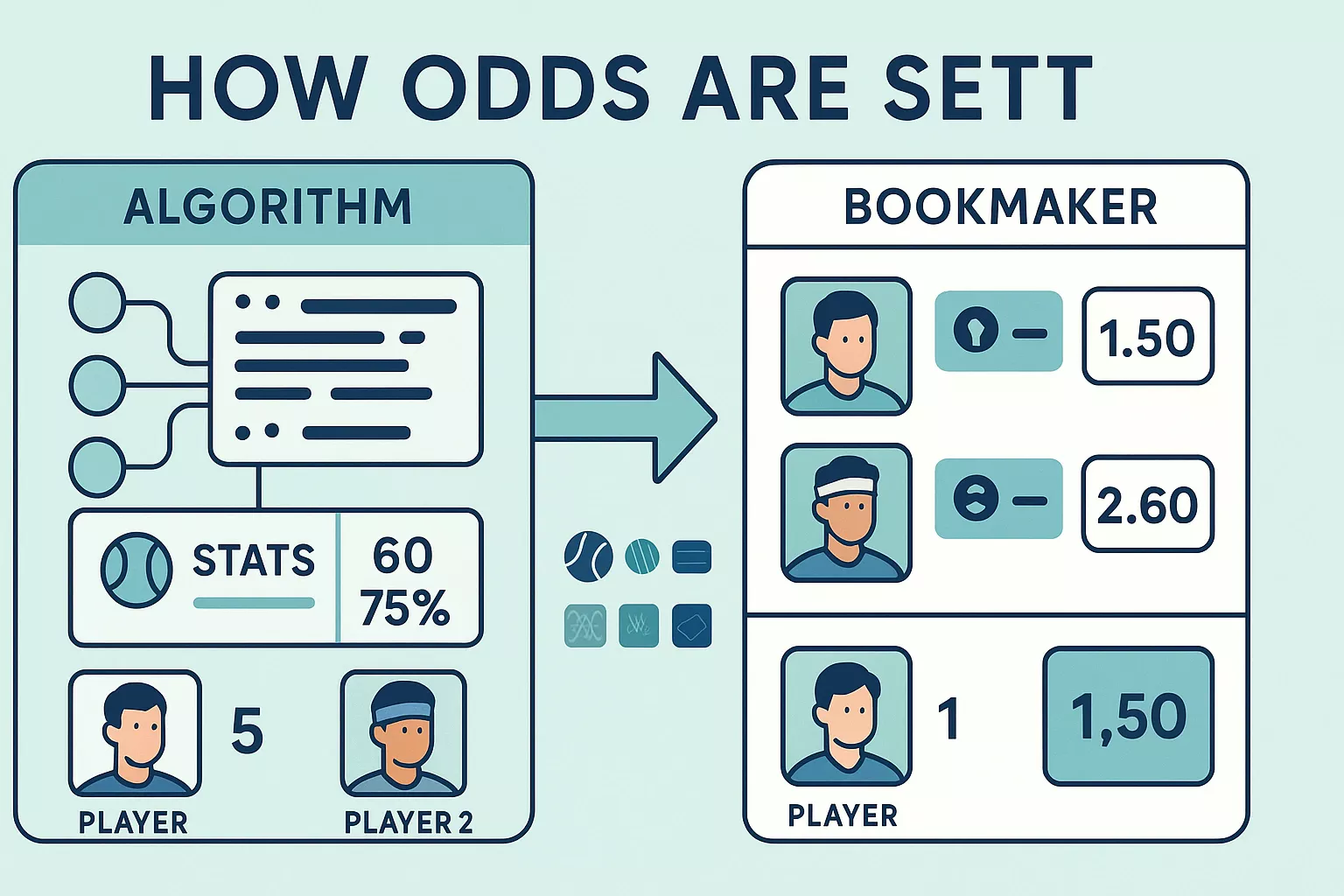
Bookmakers start with algorithms that incorporate player rankings, recent form, head-to-head records, and surface statistics. These algorithms spit out initial probabilities which get converted to odds. For major matches at Grand Slams or Masters 1000 events, bookmakers might have dedicated traders who adjust these algorithmic lines based on additional factors. But for smaller ATP 250 matches, especially early rounds? The lines are often purely algorithmic with minimal human oversight.
This creates the first opportunity. Algorithmic lines rely on data feeds and statistical models that don’t capture everything. They miss intangibles like motivation, physical condition, and specific matchup dynamics that watching tennis regularly reveals. When you’ve identified something the algorithm missed, you’ve found potential value.
The opening line isn’t designed to reflect true probabilities it’s designed to attract balanced action on both sides. Bookmakers are bookies, not oracles. They want equal money on both players so they can profit from the vig regardless of outcome. This means opening lines are often set based on where bookmakers expect public money to flow rather than pure win probabilities.
Understanding this distinction is crucial. A player might be a 65% favorite to win a match, but if the bookmaker expects heavy public betting on that player, they might set the line as if the player is a 70% favorite. That 5% gap represents value for anyone willing to bet against the public.
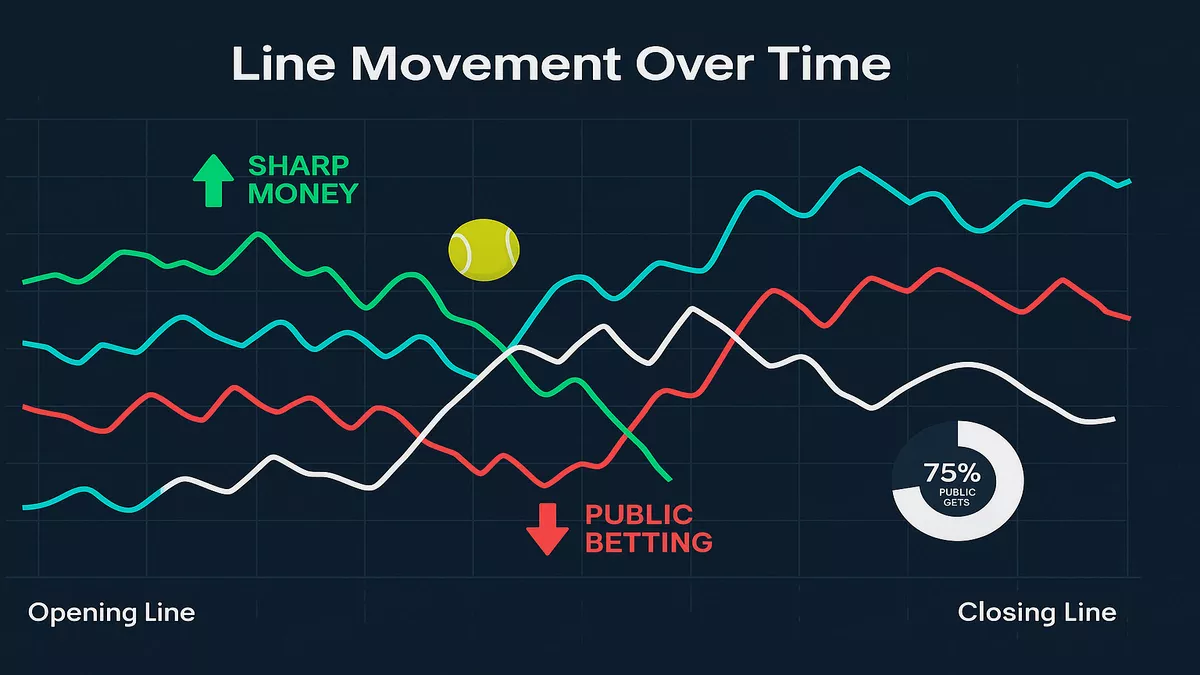
Line movement after the opening provides critical information. Sharp money bets from professional bettors with strong track records causes bookmakers to adjust their lines. If a line moves from -150 to -170, smart money hit the favorite. If it moves from -150 to -140, smart money is on the underdog. Following these movements helps identify where sophisticated bettors are finding value.
However, line movement can also be purely public-driven. When a famous player’s match gets heavy casual betting, lines move to balance the book rather than reflect new information. Distinguishing between sharp movement and public movement is an art. Sharp money typically comes in early, in larger amounts, and moves lines quickly. Public money trickles in throughout the day, moves lines gradually, and intensifies closer to match time.
The closing line is theoretically the most efficient price. By the time a match starts, all information is incorporated, sharp bettors have made their moves, and the market has reached equilibrium. This is why beating the closing line is the gold standard for measuring betting skill. If you consistently get better prices than the closing line, you’re identifying value that the market eventually recognizes.
Market Movement Analysis and Sharp Money Identification
Learning to read market movement is like learning a new language. The odds are constantly telling you a story you just need to understand what they’re saying.
Reverse line movement is the clearest signal of sharp action. This happens when the majority of bets are on one side but the line moves toward the other side. For example, 75% of bets might be on the favorite, but the line moves from -140 to -130, making the favorite less expensive. This tells you that despite more bets coming in on the favorite, the bigger money the sharp money is on the underdog. Bookmakers respect this money and adjust accordingly.
I track reverse line movement religiously. When I see it in tennis matches, especially at smaller tournaments where lines are softer, it’s often a strong indicator to follow the sharp money. These professional bettors have information or analytical edges that caused them to take a position contrary to public sentiment. More often than not, they’re seeing something the market missed.
Steam moves are rapid, coordinated line changes across multiple bookmakers simultaneously. This happens when a syndicate or group of sharp bettors hits multiple books at once with large bets. Suddenly the line jumps from -140 to -160 within minutes across five different sportsbooks. These moves are pure gold for identifying sharp opinion. The challenge is catching them in real time, which requires monitoring multiple books or using odds comparison services.
Early sharp action differs from late public money in predictable ways. Sharp bettors bet early to get the best number before the market adjusts. They do their homework before lines are posted and bet immediately upon release. Public bettors bet closer to match time they’re often deciding what to bet while scrolling through available matches. When you see heavy early action moving a line, that’s typically sharper than action flooding in an hour before match time.
Bookmaker line differences reveal where value might exist. When one bookmaker has a player at -150 and another has them at -165, someone’s wrong. Maybe both are wrong, but there’s definitely inefficiency. The question becomes: which book has it right? Usually, the sharpest books those that take the largest limits and attract the most professional action have the most accurate lines. When softer recreational books have different lines, that’s where value often exists.
I maintain a mental hierarchy of bookmaker sharpness. Pinnacle, for instance, is known as one of the sharpest sportsbooks for tennis. Their lines move quickly, their limits are high, and they attract professional bettors. When Pinnacle’s line differs significantly from recreational books, I trust Pinnacle’s line as more accurate. This helps me identify which side of a mismatch represents value.
Odds comparison is not optional for serious tennis betting. You need to see multiple lines simultaneously to identify where books are offering the best price on your intended bet. A difference between -140 and -150 seems small but adds up enormously over hundreds of bets. Getting an extra ten cents on every bet compounds into thousands of dollars annually.
Public Betting Patterns and Contrarian Opportunities
The betting public casual recreational bettors exhibits predictable biases that create exploitable value. Understanding these patterns is like having a roadmap to where markets will be inefficient.
Favorite bias is the most prominent public tendency. Recreational bettors love betting favorites. There’s something psychologically comforting about backing the player expected to win. This means favorites, especially obvious favorites, get bet more heavily than underdogs. To balance their books, bookmakers shade favorite lines higher than true probability justifies. This creates value on underdogs.
I’ve tracked this across thousands of matches and the data is clear: underdogs win more often than their odds imply in heavy public betting scenarios. When a match has 80% of bets on the favorite but only 60% of total money, that tells you small recreational bets are flooding the favorite while sharper, larger bets are on the dog. The dog almost always represents better value in these situations.
Recency bias causes the public to overweight recent results. A player wins a tournament last week and suddenly they’re getting bet heavily this week, regardless of whether the circumstances are comparable. Maybe last week’s tournament was on clay and this week is hard court. Maybe they beat weak opposition last week and face elite competition this week. The public doesn’t differentiate they just remember the player won recently.
This creates consistent value fading recent tournament winners in their next event, especially if surface or competition quality changed. The player’s odds will be shorter than justified because the market is influenced by recency bias. Smart money recognizes the context shift and bets accordingly.
Name recognition creates massive inefficiencies in tennis betting. When Roger Federer was still playing, his matches would see enormous public betting regardless of his actual form or matchup. The same happens now with players like Novak Djokovic, Rafael Nadal, or rising stars who capture public attention. These players get overbet simply because casual fans recognize their names and want action on marquee players.
The value is often on their opponents talented players who don’t have the name recognition but might actually have favorable matchups. I’ve made consistent profit over the years betting against aging legends in early round matches at smaller tournaments where their motivation was questionable but their name recognition kept their odds inflated.
The halo effect causes the public to overvalue players who just beat a top player. If a player ranked 50 upset the world number three last round, the public assumes they’re suddenly playing elite tennis and bets them heavily next round. But upsets happen for various reasons the favorite having an off day, lucky breaks, temporary hot streaks. These don’t necessarily predict sustained excellence.
When I see a player who pulled an upset getting heavy public betting in their next match, I immediately dig into why the upset happened. If it was legitimate dominance, fine. But if it was a close match that could have gone either way, or if the upset player had specific stylistic advantages that won’t apply in the next match, betting against them often provides value.
Grand Slam tournaments bring enormous public money that creates value opportunities. Casual fans who ignore tennis all year suddenly bet Wimbledon or the US Open. They bet based on reputation, recent headlines, or even just which player they’ve heard of. This influx of uninformed money moves lines in ways that create edges for those who’ve been paying attention all season.
The best value at Grand Slams often comes in first week matches between a famous player and a lesser-known opponent. The public piles on the famous name, inflating the odds beyond what’s justified. Meanwhile, the lesser-known player might be in excellent form, have a favorable stylistic matchup, or be playing at a tournament where conditions suit their game perfectly.

Statistical Value Models and Probability Assessment
Building your own probability models sounds intimidating but it’s simpler than you think. You don’t need a PhD in statistics you need consistent data tracking and basic mathematical understanding.
The foundation of any value betting approach is comparing your probability assessment to the bookmaker’s implied probability. If you think a player has a 60% chance of winning but the bookmaker’s odds imply only a 55% probability, you’ve potentially found value. The key word is “potentially” your assessment needs to be more accurate than the bookmaker’s, which requires real analytical edge.
Expected value calculations tell you whether a bet is profitable long-term. The formula is straightforward: multiply the probability of winning by the amount you’d profit, then subtract the probability of losing multiplied by your stake. If the result is positive, the bet has positive expected value. Make enough positive expected value bets and you’ll profit regardless of short-term variance.
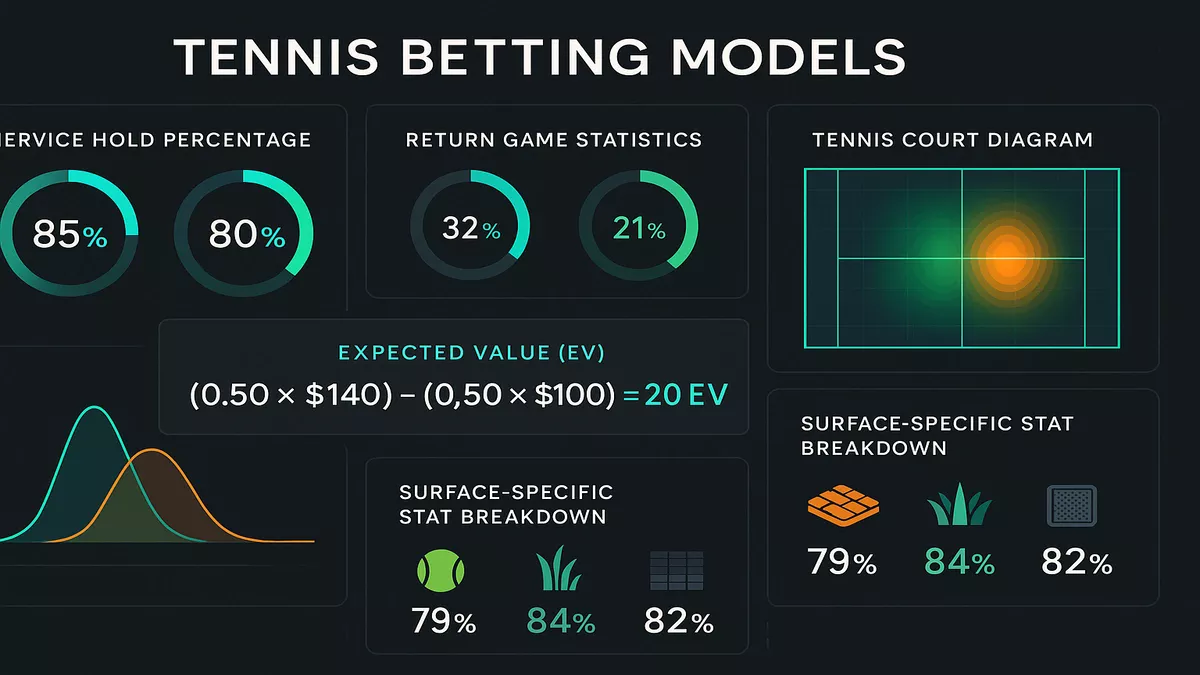
Here’s a practical example. You’re offered +140 odds on an underdog, which implies about 42% probability. You’ve analyzed the matchup and believe the underdog actually has a 50% chance to win. A $100 bet would return $240 if successful (your $100 stake plus $140 profit). The expected value calculation is: (0.50 × $140) – (0.50 × $100) = $70 – $50 = $20 expected value. That’s a profitable bet regardless of whether this specific instance wins or loses.
The challenge is accurately assessing true probability, which is where most bettors fail. They convince themselves their assessment is accurate when they’re really just rationalizing a bet they want to make. Honest self-assessment is critical. You need to track your predictions against actual outcomes over large samples to verify whether your probability assessments are genuinely better than market consensus.
I maintain spreadsheets tracking every bet I consider, my assessed probability, the odds I got, and the outcome. After hundreds of bets, patterns emerge. Maybe I consistently overestimate underdog chances on clay courts. Maybe I’m excellent at assessing grass court matches but mediocre on hard courts. This data tells me where my actual edge exists versus where I think I have edge.
Service and return statistics form the backbone of quantitative tennis analysis. A player’s service hold percentage and return games won percentage predict match outcomes surprisingly well. If Player A holds serve 85% of the time and breaks opponent’s serve 25% of the time, while Player B holds 80% and breaks 20%, you can model expected set scores and match probabilities. These models won’t be perfect but they provide objective baselines.
Surface-specific statistics are crucial. A player’s overall serve statistics might be solid, but if you’re betting a clay court match and their clay-specific serve statistics are mediocre, the overall numbers are misleading. Always segment data by surface when building probability models. The player who holds serve 85% on hard courts might only hold 75% on clay, which dramatically changes match dynamics.
Remember that price value fluctuates wildly depending on the environment, so always apply surface-specific tennis betting strategies before wagering.
Head-to-head records provide valuable information but need proper context. If two players have met five times and one leads 4-1, that seems significant. But dig deeper: were all five matches on the same surface? Were the matches recent or spread over many years? Has either player’s game evolved significantly since their last meeting? Raw head-to-head numbers matter less than contextual head-to-head analysis.
Recent form matters but needs intelligent interpretation. A player who’s lost three straight matches sounds like bad form, but maybe those losses came against top-five opponents in close three-set battles. That’s actually decent form in tough circumstances. Meanwhile, a player who won three straight might have beaten players ranked outside the top 100 in straight sets. Those wins are less impressive than they initially appear.
I weight recent matches by opponent quality and match closeness. Beating the world number ten in a tight three-setter tells me more about current form than beating three players ranked 80-100 in routine straight setters. Quantifying this requires assigning weights to different quality wins and losses, but the effort pays off in more accurate form assessments.
Psychological Factors and Market Narratives
Markets don’t just respond to objective data they respond to narratives and psychological biases that create inefficiencies sharp bettors can exploit.
Revenge narratives occur when two players meet shortly after their previous encounter. If Player A beat Player B convincingly last month, the public often assumes Player A will dominate again. But players learn from losses, make adjustments, and sometimes return highly motivated for revenge. These revenge spots create value on the player who lost previously, especially if the public is overconfident in the repeat outcome.
I specifically seek these revenge matchups within short timeframes players meeting again within 2-3 months after a decisive previous result. The loser is often undervalued as the market assumes nothing changed. But motivated players make adjustments, and outcomes regress toward the mean more than the public expects.
Injury return situations are consistently mispriced. When a top player returns from injury, the market faces uncertainty no one knows if they’re truly healthy or still impaired. Early betting often assumes the worst, pricing the player as if they’re compromised. But if you’ve followed their practice sessions, read injury reports carefully, and assessed whether they’d risk returning if not genuinely healthy, you can get value on returning players before the market recognizes they’re back to form.
Conversely, sometimes players return too quickly from injury, announcing they’re healthy when they’re really only 80%. These situations require careful judgment. The value is in being right about which injured players are truly ready versus which ones are rushing back.
Career trajectory narratives affect odds significantly. Young rising players get discounted early in their ascent. They might have beaten several top players and shown elite skills, but their ranking lags behind their actual ability. The market partially discounts them because they “haven’t proven themselves yet.” If you identify these rising players early before they break into the top 20 and the market fully adjusts you can get tremendous value backing them.
Similarly, declining veterans get overvalued based on past reputation. The market is slow to accept that a former top-ten player is no longer that caliber. They might have slipped to 30th in the rankings, but betting markets still price them closer to their peak years than their current ability. Fading these players, especially against motivated opponents, creates consistent value.
Media narratives create betting inefficiencies. When tennis media builds hype around a player declaring them the next big thing or suggesting they’re peaking at the perfect time public money follows. These narratives aren’t always wrong, but they’re often premature or exaggerated. The resulting odds inflation on hyped players and deflation on overlooked players creates value for contrarians willing to go against the story.
I make a point of identifying which media narratives are actually supported by data versus which are just compelling stories. Sometimes the story is real and the hype is justified. Other times it’s sports media manufacturing drama, and betting markets overreact. Distinguishing between the two is where profit lives.
Emotional betting after big moments creates short-term inefficiencies. After a player saves multiple match points to win in epic fashion, their next match odds will be shorter than justified because that dramatic win is fresh in everyone’s mind. But dramatic wins don’t predict future success they’re single data points in noisy data. The emotional market reaction creates value on the opponent who’s getting longer odds than deserved.
Bookmaker Margin Exploitation and Arbitrage
Understanding how bookmakers make money reveals where value opportunities consistently exist.
The vigorish or margin is the built-in advantage bookmakers have on every bet. Convert all odds to implied probabilities and sum them up the total will exceed 100%. The excess is the bookmaker’s margin. On tennis moneylines, margins typically range from 2% to 6% depending on the bookmaker. Sharp books have margins around 2-3%, recreational books often 5-6% or higher.
This means you need to beat not just the true probability but also the bookmaker’s margin to profit. If a match is genuinely 50-50 but the bookmaker offers -110 on both sides (about 52.4% implied probability each), you need to correctly identify situations where one side is better than 52.4% just to break even after the margin.
The solution is betting at lower-margin bookmakers when possible. Pinnacle, for instance, operates on notoriously low margins, which means their prices are closer to true probabilities. You give up less in vigorish every bet. This compounds enormously over time the difference between 2% margin and 5% margin is the difference between profitability and slow bankruptcy for many bettors.
Line shopping across multiple bookmakers is mandatory for serious betting. Different books offer different prices on the same match, and always betting the best available price dramatically improves long-term results. If you’re betting $100 per match and improve your average price by just five cents through line shopping, that’s $5 per bet or $500 over 100 bets. That’s real money that requires minimal extra effort.
I maintain accounts at five or six bookmakers and check prices across all of them before placing any bet. It takes an extra two minutes per bet but adds up to thousands of dollars annually. The bettors who consistently win long-term are almost always the ones shopping for best prices.
Bonus and promotion optimization is an underutilized form of value extraction. Bookmakers offer deposit bonuses, risk-free bets, odds boosts, and other promotions to attract customers. These promotions provide mathematical value if used strategically. A 50% deposit bonus up to $500 is literally free money if you understand the rollover requirements and bet intelligently.
I treat promotions as part of my overall betting edge. When a book offers a 25% odds boost on tennis matches, I calculate whether the boosted odds create positive expected value on matches where I already had marginal interest. These promotions are designed to attract betting volume, but smart bettors extract real value from them.
Reduced juice days are when bookmakers lower their margins as promotions. A book might offer tennis moneylines at -105 instead of -110, cutting their margin in half for a day. These promotions dramatically improve your expected value and are perfect times to increase betting volume on matches where you have legitimate edge.
Timing Your Bets for Maximum Value
When you place your bet matters almost as much as what you bet.
Opening lines offer the best value for sharp bettors who’ve done their homework in advance. Before the match, before public money floods in, before sharp adjustments occur that’s when inefficiencies are largest. If you can analyze matchups before lines are posted and bet immediately when they go live, you’re competing against algorithms rather than the wisdom of the crowd. Algorithms have weaknesses that human analysis can exploit.
I prepare my analysis the night before or morning of match days, so when lines post I know exactly which bets I want to make. This preparation allows me to bet within minutes of line release, getting numbers that might move significantly by the time the public starts betting.
Live betting during matches creates unique value opportunities. Odds shift dramatically based on match flow, but these in-play shifts sometimes overreact to short-term momentum. A player loses the first set and their odds lengthen substantially, but maybe that player is historically strong in comebacks or the first set was closer than the score indicated. Betting them live captures value that wasn’t available pre-match.
The challenge with live betting is execution speed and emotional discipline. You need to assess situations quickly, resist recency bias, and place bets fast before odds shift. This requires experience reading match flow in real time, which develops only through watching thousands of matches.
Common Value Betting Mistakes to Avoid
Even experienced bettors fall into traps that destroy value and create losing patterns.
Confirmation bias is the killer of objective analysis. You decide you like a player, then seek information supporting that conclusion while ignoring contradictory evidence. You tell yourself you’re doing analysis but you’re really just rationalizing a predetermined decision. The only solution is rigid discipline force yourself to articulate the case against your intended bet before placing it.
I use a mental checklist before every bet. What’s the case for the other side? What could I be wrong about? What information might I be missing or misweighing? If I can’t articulate solid counterarguments to my own position, I probably haven’t analyzed thoroughly enough.
Betting too frequently destroys value. Not every match offers exploitable value. Sometimes both players are fairly priced and there’s simply no edge available. But bettors get bored, want action, or convince themselves they see something that isn’t there. They bet matches they should pass, usually at fair or negative expected value, which drags down overall results.
The discipline to pass on matches without clear edge separates winners from losers. I probably pass on 70% of available matches because after honest analysis, I don’t see sufficient mispricing to justify a bet. That restraint preserves capital for spots where genuine edge exists.
Value betting in tennis isn’t about having some secret information no one else possesses. It’s about systematic advantage in analyzing matchups, understanding market mechanics, identifying psychological biases, and having the discipline to bet only when edge exists. These advantages compound over time into consistent profitability, but only if you approach betting as a long-term analytical process rather than short-term gambling.
Discover reliable tennis betting platforms that offer early lines and professional-grade features.
